

Summary: Solar photovoltaic (PV) panels convert sunlight directly into electricity through the photovoltaic effect. This article explains in detail how solar cells work, their structure, and the key factors affecting their efficiency.
Detailed Content:
1. Basic Working Principle:
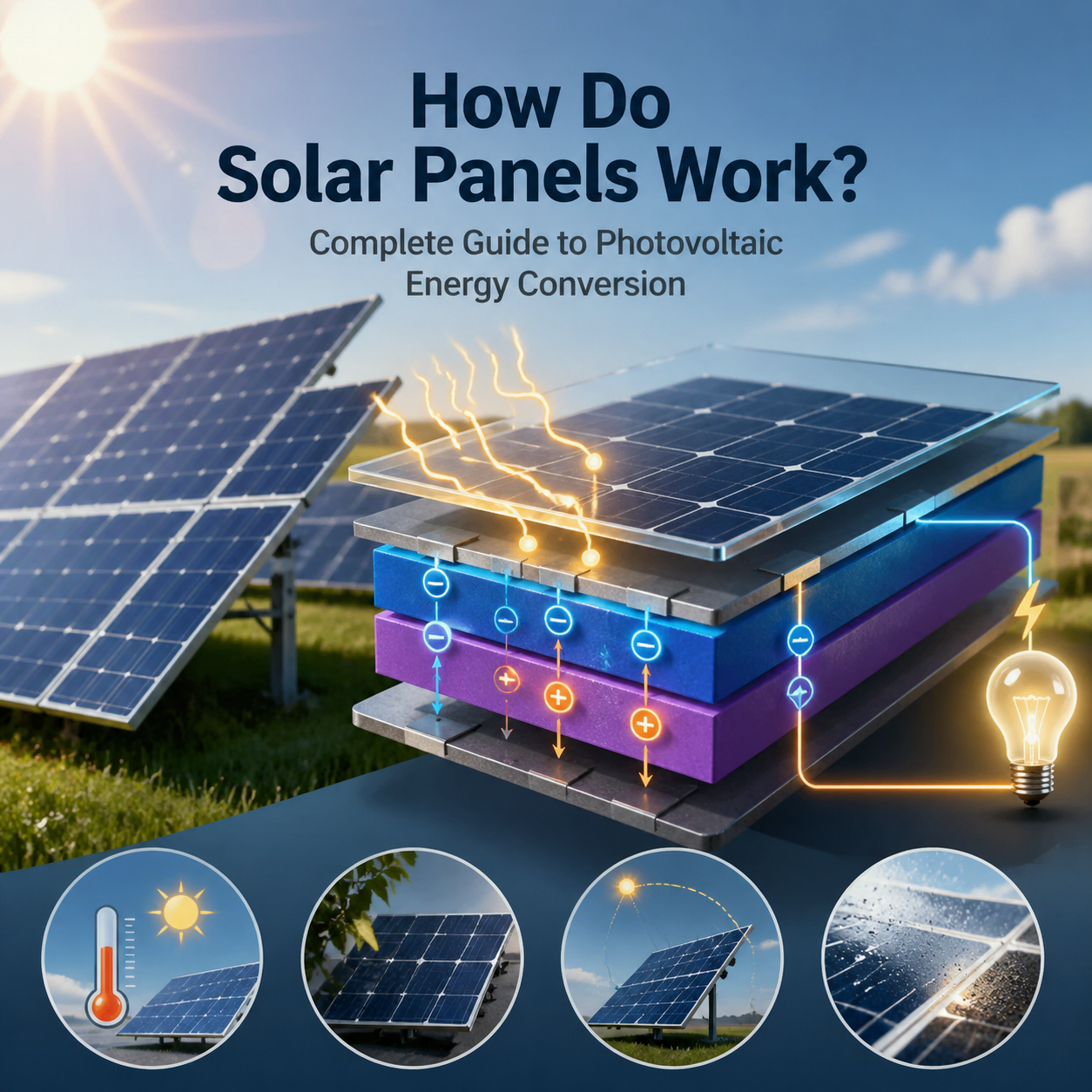
Photon Absorption: Photons (light particles) from sunlight strike the semiconductor layer (usually silicon) of the solar cell.
Electron Excitation: The photon’s energy knocks electrons loose from their atoms.
Electric Field Creation: The P-N junction (the boundary between positive (P-type) and negative (N-type) semiconductor layers) creates an internal electric field that separates the freed electrons and the resulting “holes” (positive charge carriers).
Current Generation: The separated charges flow through an external circuit, generating direct current (DC) electricity.
2. Solar Cell Structure:
Anti-Reflective Coating: Minimizes light reflection, maximizing absorption.
N-type Semiconductor Layer: Rich in free electrons (negative charge).
P-type Semiconductor Layer: Rich in holes (positive charge).
P-N Junction: The electric field region formed at the interface of the two layers.
Metal Contacts/Electrodes: Collect and conduct the electric current.
Back Sheet: Protects the cell from environmental factors.
3. Types of Solar Cells:
Monocrystalline Silicon: Highest efficiency (18-22%), higher cost, uniform black appearance.
Polycrystalline Silicon: Medium efficiency (15-18%), lower cost, blue speckled appearance.
Thin-Film (e.g., CdTe, CIGS): Lower efficiency (10-13%), flexible, suitable for specialized applications.
4. Factors Affecting Efficiency:
Temperature: Efficiency decreases by about 0.3-0.5% per 1°C rise in temperature.
Light Intensity: Power output is roughly proportional to sunlight intensity.
Shading: Partial shading can drastically reduce the output of an entire string of panels.
Angle and Orientation: The optimal tilt angle is usually equal to the local latitude.
rCleanliness: Dust and dirt can reduce efficiency by 5-25%.
5. Practical Considerations:
Standard Test Conditions (STC): 25°C, 1000W/m² irradiance, AM1.5 spectrum.
Real-world energy yield is typically 70-85% of the panel’s rated power.
Lifespan: 25-30 years, with a typical power degradation rate of 0.5-0.8% per year.