
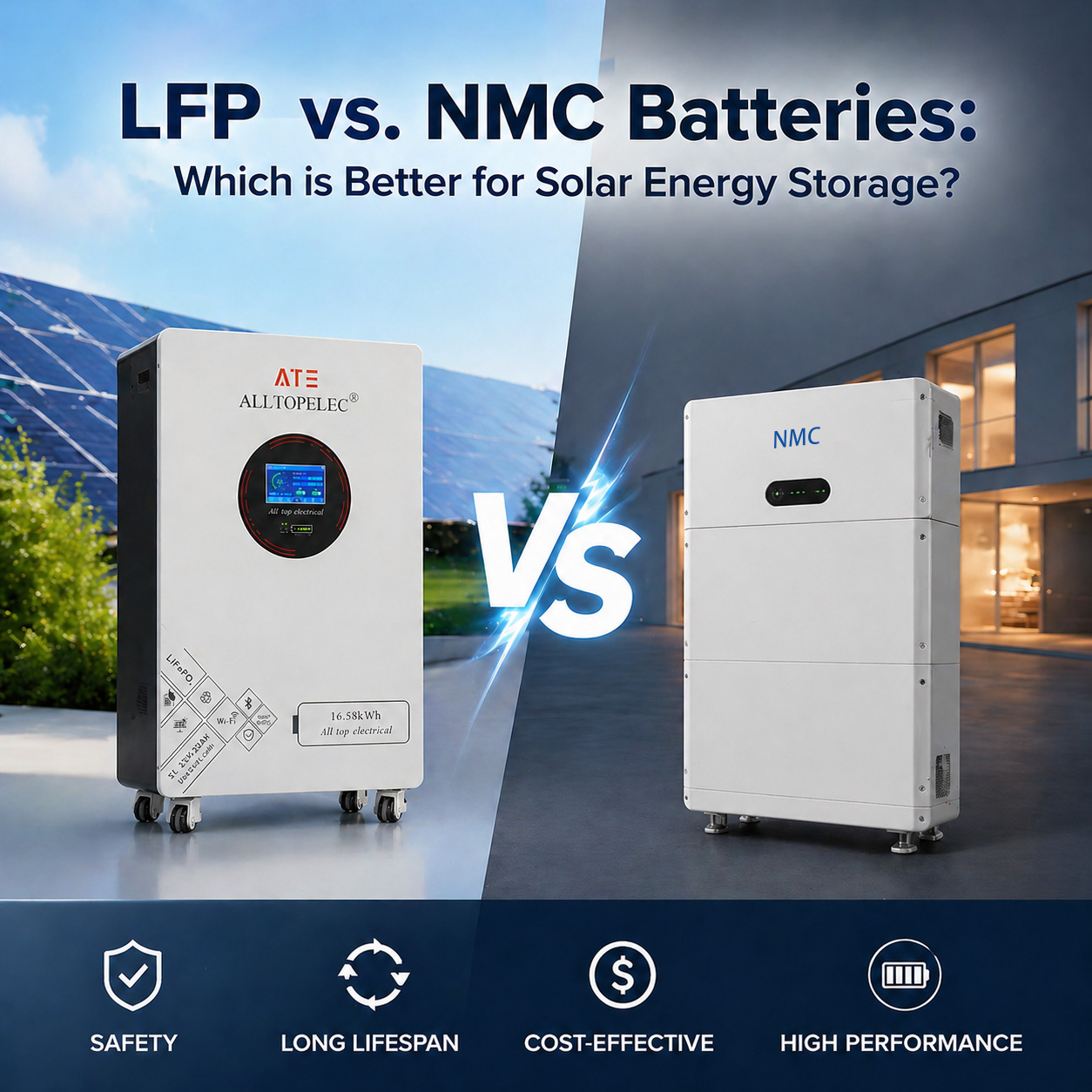
Summary: LFP and NMC are the two dominant battery chemistries for storage. This article provides a detailed comparison across safety, lifespan, cost, and performance to aid in informed decision-making.
Detailed Content:
Comparison Table:
| Feature | Lithium Iron Phosphate (LFP) | Lithium Nickel Manganese Cobalt (NMC) |
| Chemistry | LiFePO₄ | LiNiₓMnᵧCo₂O₂ or similar |
| Energy Density | 120–160 Wh/kg | 180–250 Wh/kg |
| Cycle Life | 3000–6000 cycles | 1000–2000 cycles |
| Safety | Excellent (Thermal runaway >350°C) | Moderate (Thermal runaway ~200°C) |
| Cost | Lower | Higher (contains cobalt, nickel) |
| Operating Temp. | -20°C to 60°C | 0°C to 45°C (more sensitive) |
| Environmental | No heavy metals, abundant materials | Contains cobalt/nickel, complex recycling |
| Charge Rate | Typically 1C, some 3C+ | Typically 0.5–1C |
| Voltage Curve | Flat (~3.2V) | Sloping (3.6–3.7V nominal) |
Detailed Analysis:
1. Safety:
LFP: Stable olivine structure, strong P-O bond, no oxygen release. Extremely low thermal runaway risk.
NMC: Layered structure prone to oxygen release at high temps, requires complex thermal management.
2. Lifetime & Economics:
LFP: Very long cycle life, lower total cost of ownership (TCO), ideal for daily cycling.
NMC: Higher initial energy density, faster degradation, better for space-constrained apps with less cycling.
3. Temperature Performance:
LFP: Good high-temp stability, lower performance in extreme cold.
NMC: More sensitive to temperature extremes, needs strict climate control.
4. Application Guidance:
Choose LFP if: Safety is paramount, long lifespan needed, daily cycling, budget-conscious, fixed storage.
Choose NMC if: Space/weight is critical, high energy density needed, low-temperature operation is essential.
5. Market Trend:
LFP dominates >95% of the stationary solar storage market.
Growing adoption in EVs (Tesla, BYD, etc.).
LFP’s cost advantage is strengthening with raw material price fluctuations.