
Summary: Lithium Iron Phosphate (LFP) batteries have become the ideal choice for solar energy storage due to their exceptional safety, long lifespan, and stability. This article delves into their working principles, chemical properties, and application advantages.
Detailed Content:
1. Electrochemical Principle:
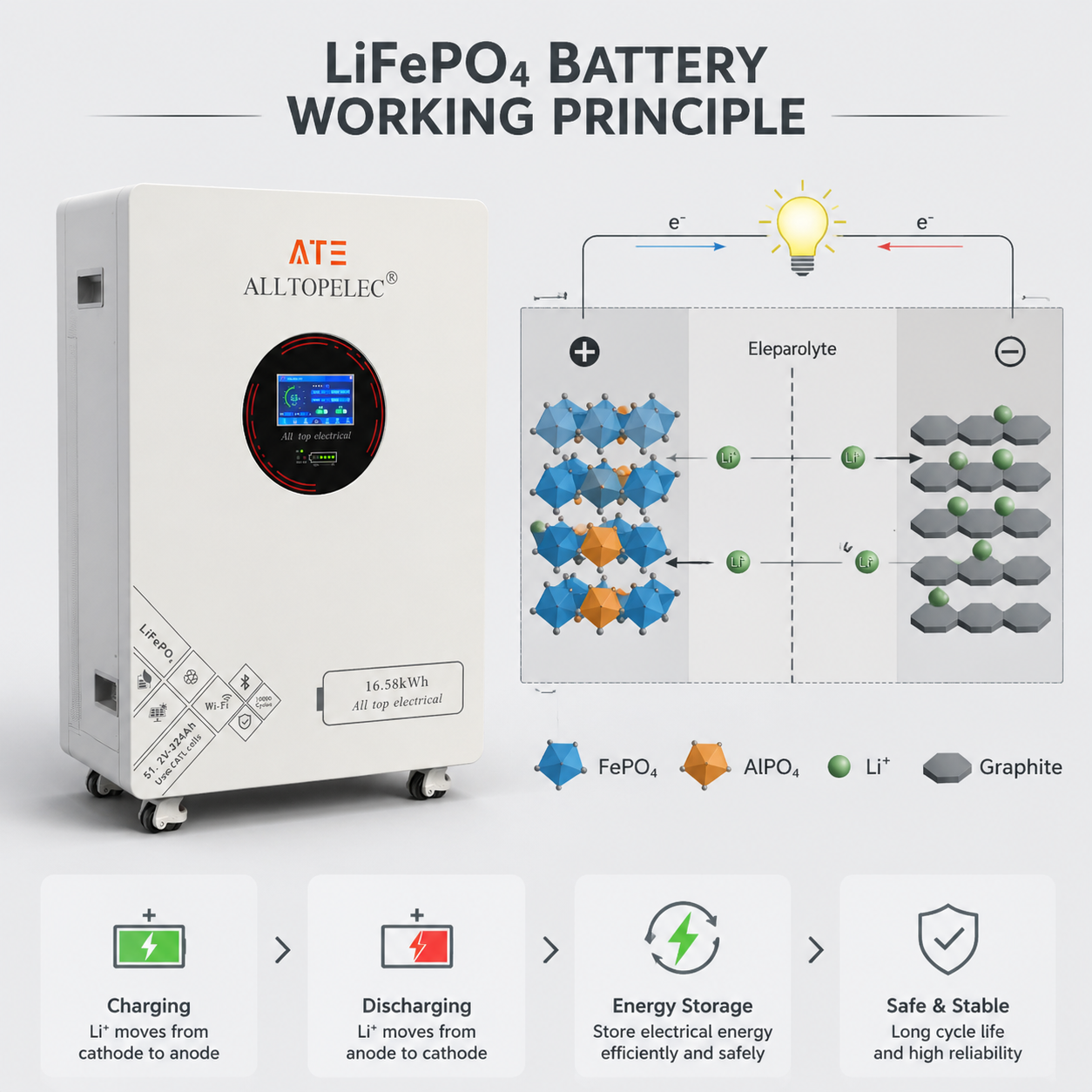
Charging: Li⁺ ions de-intercalate from the LiFePO₄ cathode, move through the electrolyte, and embed into the graphite anode.
Discharging: Li⁺ ions leave the anode and return to the cathode.
Chemical Reaction: LiFePO₄ ⇌ FePO₄ + Li⁺ + e⁻
Voltage: Nominal 3.2-3.3V, operating range ~2.5-3.6V.
2. Cell Structure:
Cathode: LiFePO₄ (Lithium Iron Phosphate).
Anode: Graphite (Carbon).
Electrolyte: Lithium salt in organic solvent.
Separator: Polyolefin microporous membrane.
Casing: Pouch (aluminum laminate) or Prismatic/Cylindrical (steel/aluminum).
3. Key Characteristics:
Thermal Stability: Decomposition temperature >350°C, much higher than NMC’s ~200°C.
Cycle Life: 3000-6000 cycles (to 80% of original capacity).
Energy Density: 120-160 Wh/kg, 150-200 Wh/L.
Power Density: High, suitable for high charge/discharge rates.
Self-discharge Rate: Low, approximately 2-3% per month.
4. Intrinsic Safety Mechanisms:
Strong P-O Covalent Bond: Does not easily release oxygen at high temperatures.
Stable Olivine Crystal Structure: Minimal volume change (<2%) during cycling.
Overcharge Tolerance: Can withstand some overcharge without thermal runaway.
Current Limitation: Higher internal impedance can limit short-circuit current.
5. Battery Management System (BMS):
Cell Balancing: Ensures uniform voltage across all cells.
Temperature Monitoring: Multiple temperature sensors.
State of Charge (SOC) Estimation: Coulomb counting with voltage calibration.
Protection: Against overcharge, over-discharge, over-current, and over-temperature.