
Best LiFePO4 Solar Battery in the Philippines (2026 Guide)
A solar battery in the Philippines is not only about lowering the evening power bill. For many homes, it is about keeping the refrigerator cold, the WiFi live and a few rooms comfortable when the grid drops. That is why the best LiFePO4 solar battery is rarely the one with the biggest number on the label. It is the battery that matches the way your household actually uses electricity during a brownout.
Why LiFePO4 is the practical choice for Philippine homes
LiFePO4, also called lithium iron phosphate, is well suited to stationary home energy storage because it is designed for frequent charge and discharge cycles and is paired with a battery management system (BMS) that monitors the pack. For a house with solar, it can store surplus daytime production and release it later at night or during an outage.
The chemistry alone does not guarantee a good system. A usable home backup setup also needs a correctly sized hybrid inverter, proper protection devices, sensible cable sizing and an installer who understands the local electrical layout. In coastal and hot locations, give extra attention to a dry installation area, ventilation and protection from direct sun or flood exposure.
Start with the brownout loads, not the battery label
List the appliances you truly want to keep on. A practical essential-load circuit may include one refrigerator, modem and WiFi router, LED lights, electric fans, phone charging and selected outlets. Add an inverter aircon only after you have checked its running draw and startup behavior.
Then decide how long you want those loads to run without solar help. A home that needs 800W on average for eight hours needs roughly 6.4kWh delivered to the appliances. The battery must be larger than this once normal depth-of-discharge limits and inverter losses are considered. This simple calculation prevents the common mistake of buying a battery based on household size alone.
Which ALLTOPELEC capacity fits your household?
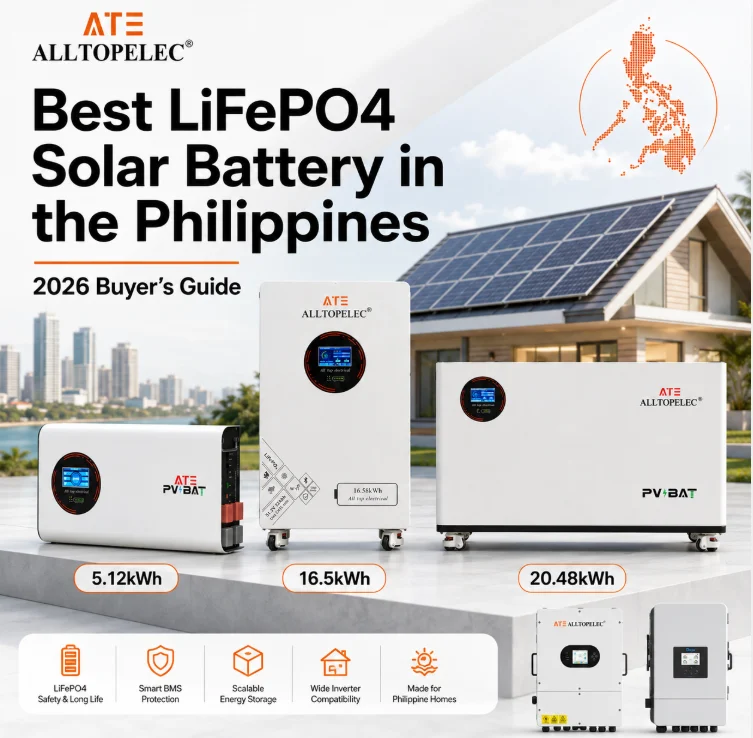
A 5.12kWh unit is a sensible entry point for essential backup. It is appropriate for light evening loads or a short brownout plan: refrigerator, lights, WiFi, fans and charging. It is not the right answer for a house that expects to run several aircons.
The 16.5kWh ALLTOPELEC battery is the stronger fit for families that want a more comfortable backup window. Its 51.2V, 324Ah specification gives meaningful stored energy for longer essential-load operation or careful use of a single inverter aircon. The product is specified with CAN, RS485 and RS232 communications, smart monitoring and parallel expansion capability.
For larger loads, longer outages or a future expansion plan, a 20.48kWh class battery gives more energy headroom. Capacity, however, is only half of the decision. Check the battery’s continuous discharge current and the inverter’s battery input requirement before assuming it can support a 10kW home load at full output.
Five checks to make before you buy
First, verify voltage class. A 48V or 51.2V low-voltage battery must be paired with a compatible low-voltage inverter; it cannot simply replace a high-voltage battery stack.
Second, verify closed-loop communication. CAN or RS485 communication lets the inverter and BMS coordinate charge limits, discharge limits and state of charge. Ask for the exact inverter model, firmware requirements, cable pinout and recommended battery profile before shipment.
Third, compare usable energy instead of nominal kWh alone. A battery’s recommended depth of discharge, inverter efficiency and reserve setting all affect what reaches your appliances.
Fourth, match discharge power to your peak load. A large kWh figure does not automatically mean the pack can deliver a large continuous current.
Fifth, plan the installation. A wall or floor must support the battery weight, the location must remain dry and accessible, and the essential-load panel should be designed so that high-draw appliances do not empty the battery unintentionally.
The best choice is the one you can use every day
The best LiFePO4 solar battery for a condo, a family home in Metro Manila, a provincial house or a small negosyo will not be identical. The right choice comes from the load list, the target backup hours, the inverter model and the option to expand later.
ALLTOPELEC offers 5.12kWh, 16.5kWh and 20.48kWh home storage options for customers building a hybrid or off-grid system. Share your appliance list, inverter model and preferred backup hours with the team before ordering. That is the fastest route to a battery system that feels useful during the next brownout rather than merely impressive on paper.
Frequently asked questions
What is the best LiFePO4 battery size for a Philippine home? For essential loads, 5kWh may be enough. Homes that need a longer backup window or one carefully managed inverter aircon often look at 16kWh to 20kWh. Size it from actual load and desired runtime.
Can LiFePO4 batteries handle hot Philippine weather? They can be used in Philippine conditions when installed within the manufacturer’s temperature limits in a dry, shaded, ventilated location. Never place the battery in direct sun, a damp outdoor area or a flood-prone space.
Can I expand the battery later? Many 51.2V LiFePO4 systems support parallel expansion, but every added pack must follow the product’s wiring, communication and commissioning requirements. Confirm the permitted number of units before purchase.
Does a bigger battery always mean more powerful backup? No. Energy capacity in kWh determines runtime; discharge current and power determine how much load the battery can supply at one time. Both must match your inverter and appliance demand.