

Compare ALLTOP LiFePO4 Battery Models in the Philippines
Use this price guide together with real product pages before choosing battery capacity. Final quotation depends on stock, installer requirements, delivery area and system design.
Solar Battery Price Philippines: 5kWh, 11kWh, 16kWh, 20kWh Cost Guide
When people ask for the solar battery price in the Philippines, they usually want one number. In reality, there are at least three: the battery price, the installed system price and the cost of the backup outcome they expect. A 5kWh battery that keeps the essentials running may be a better purchase than a larger system that has not been matched to the inverter or household load.
2026 reference pricing: product cost versus installed cost
The figures below are product-only reference prices based on listed ALLTOPELEC website pricing converted at PHP 60.94 per US dollar on 22 June 2026. They are not an all-in Philippine installation quote. Delivery, import treatment where applicable, wiring, breakers, combiner equipment, inverter, solar panels, permits, labor and site work can change the final project cost.
Use the table as a starting point for budget planning, then request a project quotation based on your city, inverter, panel capacity and backup-load plan.
Reference battery capacity and price guide
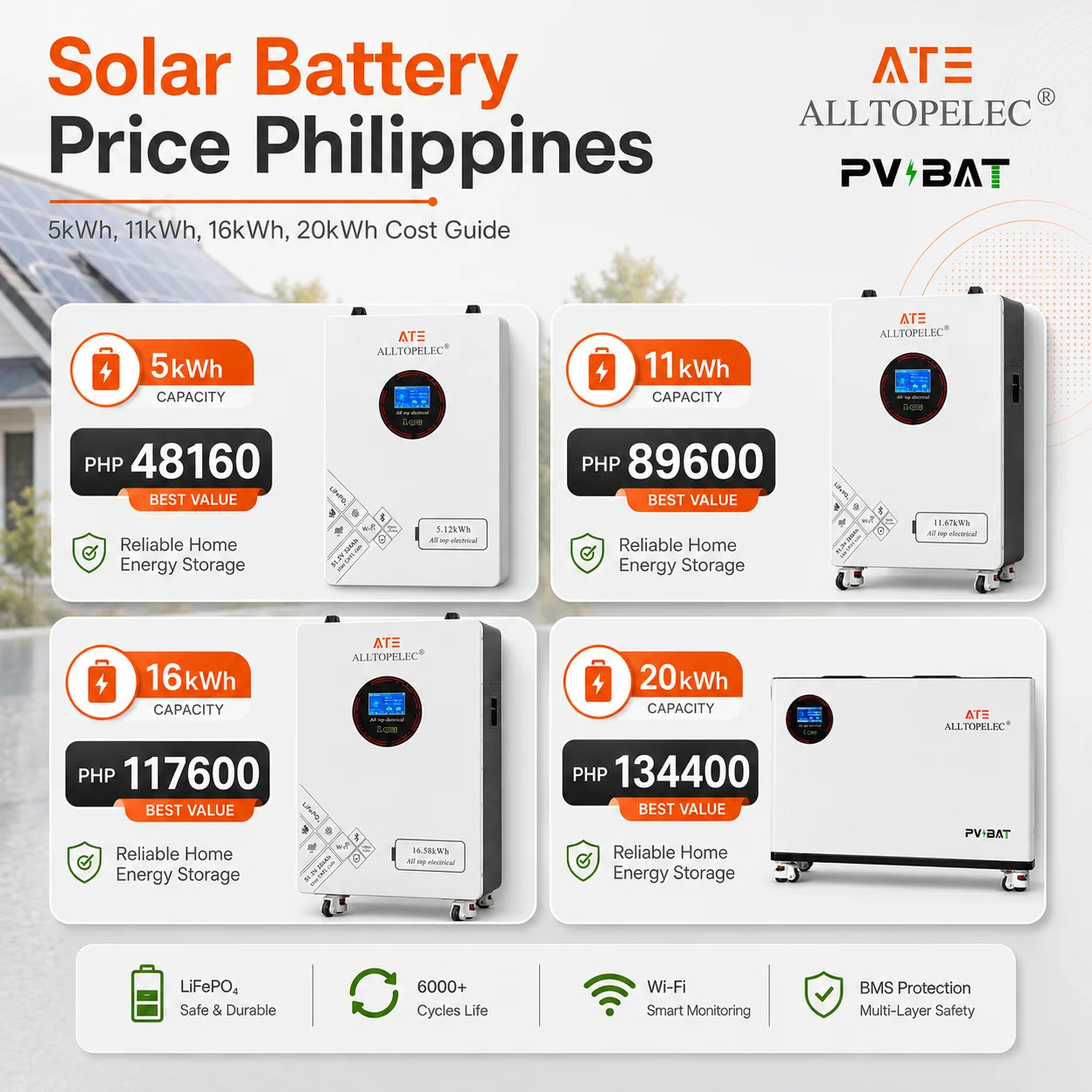
5.12kWh LiFePO4: PHP 48,160. This is a compact option for essential backup and small hybrid or off-grid systems.
10.24kWh LiFePO4: two 5.12kWh units, approximately PHP 96,320 at the same reference unit price. This creates more runtime and may improve discharge-current sharing when installed as an approved parallel system.
16kWh to 16.5kWh LiFePO4: the ALLTOPELEC 16.5kWh battery is PHP 117,600. It is aimed at households that want a more substantial backup reserve.
20.48kWh LiFePO4: PHP 134,400. This capacity is relevant where the household has larger essential loads, longer outages or a plan to use more stored solar energy after sunset.
Why a 20kWh battery is not simply four times the cost of 5kWh
Battery pricing does not scale only with cells. Larger units may include a more substantial enclosure, BMS, communications, monitoring, mechanical design and higher-current capability. On the other hand, multiple smaller packs can add hardware and installation complexity. The best value is the option that delivers the required energy and power without paying for capacity you will rarely use.
Compare price per usable kWh, warranty terms, communication support and local logistics. A low headline price becomes expensive if the battery cannot communicate with the inverter or if its continuous discharge limit is too low for the household’s peak demand.
What is included in a complete solar battery system?
A complete hybrid solar storage project normally includes the battery, a compatible hybrid inverter, PV modules, mounting structure, DC and AC protection, battery cables, isolation devices, monitoring setup and installation labor. Existing electrical panels may also need changes to create an essential-load subpanel.
For brownout backup, the essential-load arrangement matters as much as the battery. A properly designed panel prevents an electric shower, oven, pump or several aircons from switching on at once and draining the reserve faster than expected.
How to get a quote that you can compare fairly
Ask every supplier to state the nominal battery capacity, estimated usable energy, maximum continuous discharge current, battery voltage class, inverter model, solar array size and which loads will remain powered during a grid failure. Request separate lines for equipment, installation and delivery where possible.
Also ask whether the quotation assumes daytime solar will be available during an outage. A brownout in the evening is a battery-only event; a brownout at midday may be partly supported by the PV array. These scenarios produce very different runtime expectations.
A practical budget decision
Choose 5kWh when the priority is basic comfort and communications. Consider around 10kWh when the home wants a longer essential-load window. Move toward 16kWh or 20kWh when the load list includes more rooms, refrigeration, work-from-home equipment or a carefully managed inverter aircon.
Price is important, but the target should be reliable kilowatt-hours delivered to the appliances you care about. A detailed load calculation before purchase is cheaper than correcting an undersized system later.
Frequently asked questions
How much does a 5kWh solar battery cost in the Philippines?
According to ALLTOPELEC’s reference list, a 5.12kWh unit costs about PHP 48,160 before delivery, installation, and other system expenses.
How much does a 16kWh solar battery cost in the Philippines?
Based on the listed price, a 16.5kWh ALLTOPELEC battery is approximately PHP 117,600 under the specified exchange-rate reference, before project-specific costs.
Why is the installed price higher than the battery price?
A fully working backup system requires an inverter, protection devices, wiring, solar hardware, labor, and commissioning. Site conditions may also increase the total cost.
Should I buy the battery with the cheapest price per kWh?
Before deciding, you should check its battery management system (BMS), warranty, continuous current rating, and compatibility with your inverter. If the cheapest battery cannot safely support the expected load, it may not offer good value.