

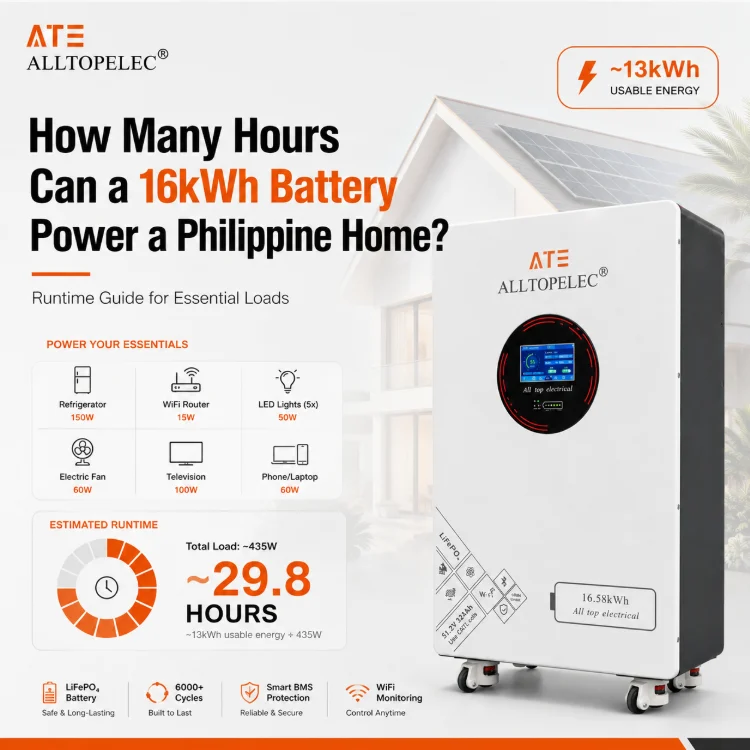
How Many Hours Can a 16kWh Battery Power a Philippine Home?
A 16kWh battery does not automatically mean 16 hours of backup. Runtime depends on the load connected to it. A home using 1kW continuously needs about 1kWh every hour; a home using 2kW needs about 2kWh every hour. The battery is the fuel tank, while your appliance demand is the engine.
Begin with usable energy
For a real-world estimate, do not plan to use 100% of the nameplate capacity. A sensible working calculation for a 16kWh LiFePO4 battery is 16kWh x 90% depth of discharge x 90% inverter efficiency. That gives roughly 13kWh available at the AC loads under typical planning assumptions.
Your actual result can be higher or lower depending on the battery reserve setting, temperature, inverter efficiency, cable losses, battery age and whether solar production is helping at the same time. Treat every runtime number as a planning estimate, not a guarantee.
Simple runtime examples
At an average 500W essential load, about 13kWh of usable energy can last around 26 hours. This may suit a modest setup with a refrigerator cycling normally, WiFi, lights, fans and charging.
At 1,000W average load, the same energy can last about 13 hours. This is a realistic ballpark for essential loads plus a larger amount of lighting, fans, work equipment or intermittent appliance use.
At 1,500W average load, expect roughly 8 to 9 hours. At 2,000W, expect about 6 to 6.5 hours. Once the home runs multiple high-draw appliances, runtime falls quickly even though the battery looks large on paper.
A Philippine brownout example
Imagine a household keeping one refrigerator, WiFi, eight LED lamps, two fans, device charging and a television on during an evening brownout. The average draw may remain under 500W to 700W because a refrigerator cycles rather than running at full power every minute. In this kind of essential-load setup, a 16kWh class battery can cover a long overnight interruption.
Now add one inverter aircon. Its average consumption can vary widely with room size, set temperature, insulation, outdoor heat and compressor speed. During a hot night, the aircon may become the largest steady load. The same battery could still be useful, but the household should expect shorter runtime and avoid adding other heavy appliances at the same time.
How solar changes the answer
If the outage happens in daylight and your hybrid system is configured to use PV power, solar generation can run part of the load and recharge the battery. That can stretch backup well beyond the battery-only estimate.
Do not plan your whole system around the best sunny-day case. A nighttime brownout, a rainy day or a heavily shaded roof can leave the battery to carry the full load. A conservative design uses the battery alone for the minimum required backup window and treats daytime solar as a bonus.
How to make a 16kWh battery last longer
Move refrigerator, lights, WiFi, fans and priority outlets to an essential-load panel. Keep resistance heating loads, electric showers, induction cooking, kettles and large pumps off the backup circuit unless the system was designed for them.
Set the aircon to a sensible temperature, close doors and curtains, use fans to improve comfort and avoid running several compressors together. The most effective saving is usually not a complicated setting: it is deciding what does not need to be powered during a brownout.
A useful rule for homeowners
Write down the watts of every priority appliance and estimate how many hours it will run. Add a safety margin. If the result is close to 13kWh, a 16kWh battery is likely in the right range. If it is much higher, consider a larger battery bank, more PV capacity, tighter load control or all three.
ALLTOPELEC can help turn that appliance list into a battery and inverter recommendation. A clear load list is more useful than a vague request for a ‘whole-home’ battery.
Frequently asked questions
How much usable energy does a 16kWh battery provide? A conservative estimate is about 13kWh after allowing for a 90% depth of discharge and 90% inverter efficiency. The exact value depends on settings and operating conditions.
Can a 16kWh battery last all night? Yes for many essential-load setups. Whether it lasts all night with aircon depends on the aircon’s average draw and the rest of the household load.
Can a 16kWh battery run a whole house? It can power a whole house only when the simultaneous load stays within the inverter and battery discharge limits. For practical brownout backup, most homes use an essential-load strategy.
Does solar recharge the battery during a brownout? A correctly configured hybrid system can use PV during daylight, subject to inverter configuration and sunlight. The exact behavior must be confirmed for the installed system.