
Summary: Traditional lead-acid batteries are being rapidly replaced by Lithium Iron Phosphate (LFP) technology. This article details the differences and explains LFP’s overwhelming advantages for solar applications.
Detailed Content:
Comparison Table:
| Feature | Lithium Iron Phosphate (LFP) | Lead-Acid (AGM/GEL) |
| Energy Density | 120–160 Wh/kg | 30–50 Wh/kg |
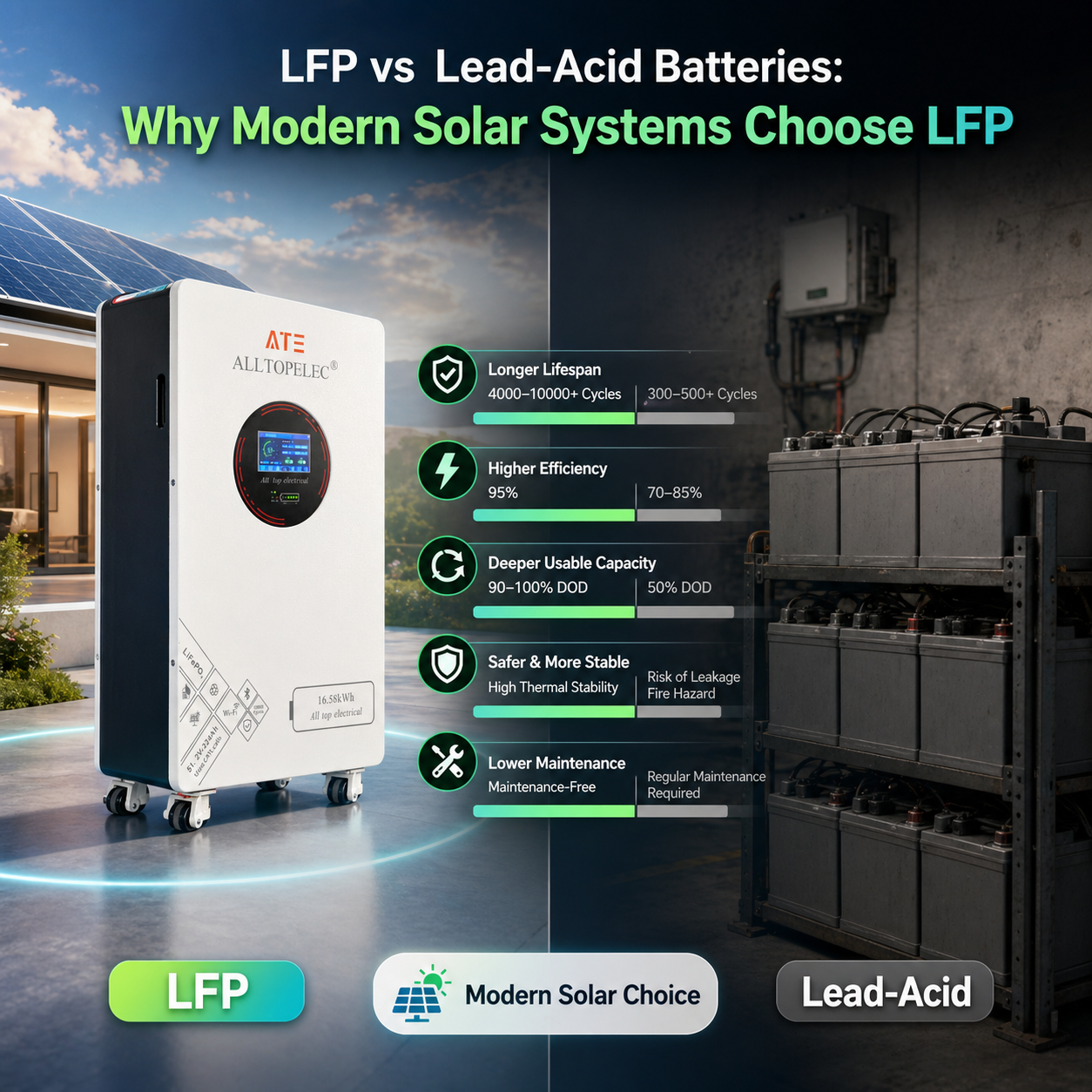
| Cycle Life | 3000–6000 cycles (80% DoD) | 300–800 cycles (50% DoD) |
| Calendar Life | 8–15 years | 3–5 years |
| Round-Trip Efficiency | 95–98% | 70–85% |
| Maintenance | Maintenance-free | Requires periodic water top-up (flooded) |
| Charge Time | 1–3 hours (fast charge capable) | 8–12 hours |
| Self-Discharge/Month | ~2–3% | ~3–5% |
| Depth of Discharge (DoD) | 80–90% recommended | 50% recommended for long life |
| Environmental Impact | No toxic heavy metals | Contains lead and sulfuric acid |
Detailed Analysis:
1. Lifetime Cost Analysis:
LFP: Higher upfront cost (2-3x) but lasts 5-10x longer. Lower Total Cost of Ownership (TCO) over 10 years.
Lead-Acid: Lower upfront cost but requires frequent replacement, leading to higher long-term cost.
2. Performance Advantages:
Depth of Discharge: LFP can be deeply discharged regularly without significant damage.
Efficiency: Higher LFP efficiency means less solar energy is wasted as heat during charging.
Power: LFP supports high discharge rates, ideal for high-power appliances.
3. Installation & Maintenance:
Weight & Space: LFP is 60-70% lighter and takes 1/3 to 1/2 the space for the same capacity.
Maintenance: LFP is truly maintenance-free. Lead-acid requires watering, equalization charges, and terminal cleaning.
Location: LFP can be installed indoors; lead-acid needs a ventilated battery room.
4. Safety & Environment:
Safety: LFP has no risk of acid leakage and is far more thermally stable.
Recycling: LFP materials are more environmentally benign and have high recycling value.
5. Practical Impact:
A home solar+storage system with LFP is significantly smaller, lighter, and more powerful.
For off-grid systems, the higher usable capacity of LFP means a smaller battery bank can be specified.