
Summary: Understand the characteristics, efficiency, and best applications of different solar panel types to choose the right technology for your needs.
Detailed Content:
Comparison Table:
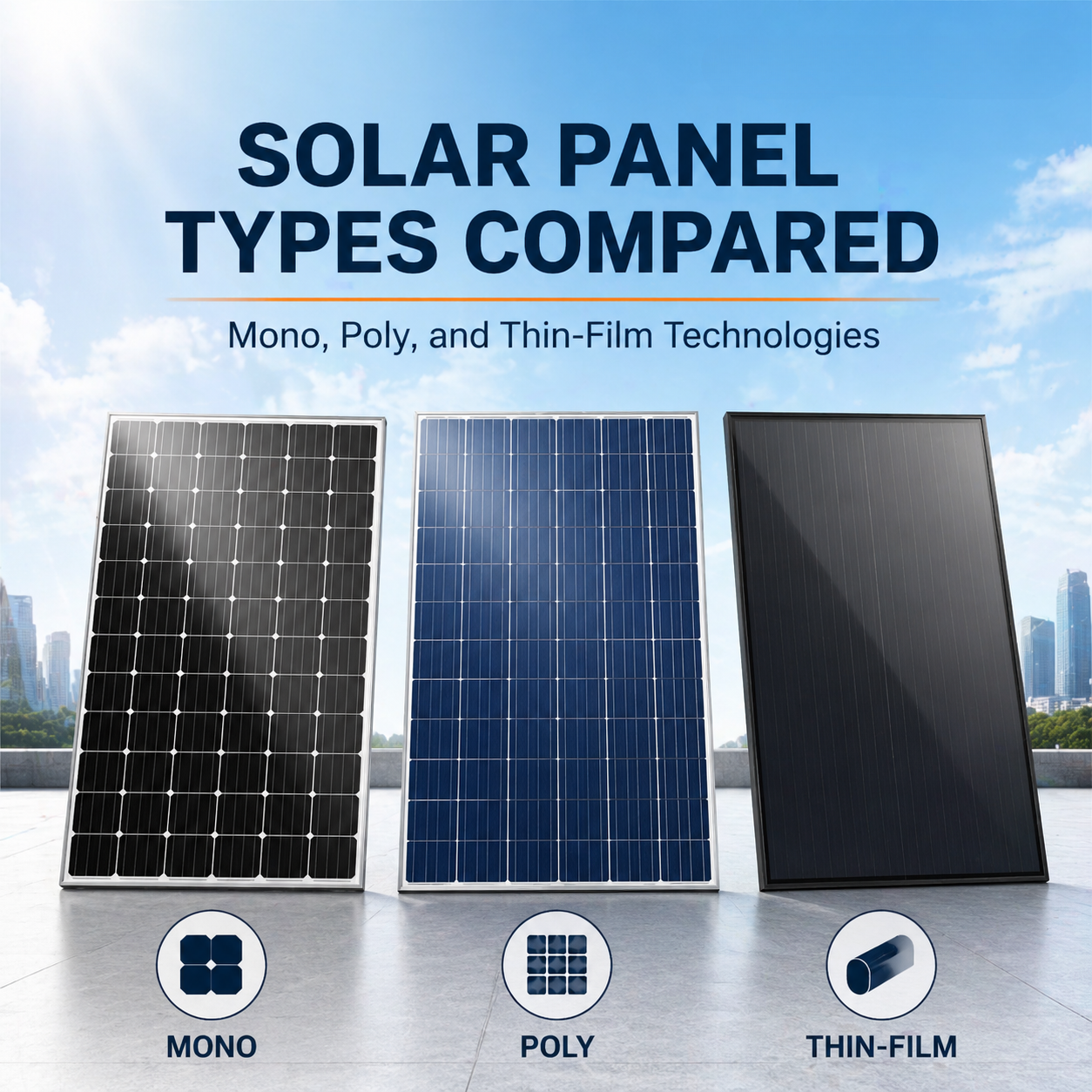
| Feature | Monocrystalline (Mono) | Polycrystalline (Poly) | Thin-Film (CdTe) |
| Efficiency | 18–22% (Highest) | 15–18% | 10–13% |
| Appearance | Uniform black, rounded cells | Blue speckled, square cells | Uniform black/brown, flexible |
| Temp. Coefficient | -0.3 to -0.4%/°C (Better) | -0.4 to -0.5%/°C | -0.2 to -0.3%/°C (Best) |
| Low-Light Perf. | Good | Fair | Excellent |
| Cost | Higher | Moderate | Lower ($/W) |
| Lifespan | 25–30+ years | 25–30 years | 20–25 years |
| Space Needed | Least | More | Most (for same power) |
| Best For | High efficiency, limited space | Budget-conscious, ample space | Large commercial roofs, BIPV, flexible surfaces |
Detailed Analysis:
1. Monocrystalline Silicon:
Made from: Single crystal silicon ingots (Czochralski process).
Pros: Highest efficiency, best space efficiency, best high-temperature performance.
Cons: Highest cost, highest embodied energy in manufacturing.
Tech Evolution: PERC, TOPCon, HJT are advanced mono technologies pushing efficiency >24%.
2. Polycrystalline Silicon:
Made from: Melted silicon fragments cast into ingots.
Pros: Lower cost, simpler manufacturing.
Cons: Lower efficiency, slightly poorer high-temp performance.
Status: Once dominant, now being replaced by more efficient mono panels.
3. Thin-Film Technologies:
Types: Cadmium Telluride (CdTe), Copper Indium Gallium Selenide (CIGS), Amorphous Silicon (a-Si).
Pros: Lightweight, flexible, good performance in high heat and low light, uniform look.
Cons: Lower efficiency, faster initial degradation, may contain rare/toxic materials.
Use Cases: Building-integrated PV (BIPV), large-scale utility plants, portable chargers.
4. Choosing the Right Panel:
Residential Rooftop: Monocrystalline is the standard choice for its efficiency.
Large Ground-Mount: Polycrystalline can be cost-effective if space is not limited.
Commercial Flat Roof: Thin-Film or high-efficiency Mono are common.
Aesthetic/BIPV: Thin-Film or black-frame Mono.
5. Quality Indicators:
Certifications: Look for IEC 61215 (design qualification) and IEC 61730 (safety).
Warranty: 10-12 year product warranty, 25-30 year linear power output warranty (e.g., 97% in year 1, degrading to >85% in year 25).